Rainy Season in Southwest Florida: How Your Yard Impacts Water Quality
 Chris Stephens
May 20, 2026 · 6 min read
Quick Answer: During Southwest Florida’s rainy season, heavy stormwater runoff turns residential yards into primary sources of water pollution. By adhering to local summer fertilizer bans, understanding drainage systems, and replacing shallow-rooted turfgrass with deep-rooted native plants, homeowners can significantly reduce harmful nutrient runoff into local waterways like the Caloosahatchee River, Estero Bay, and Charlotte Harbor.
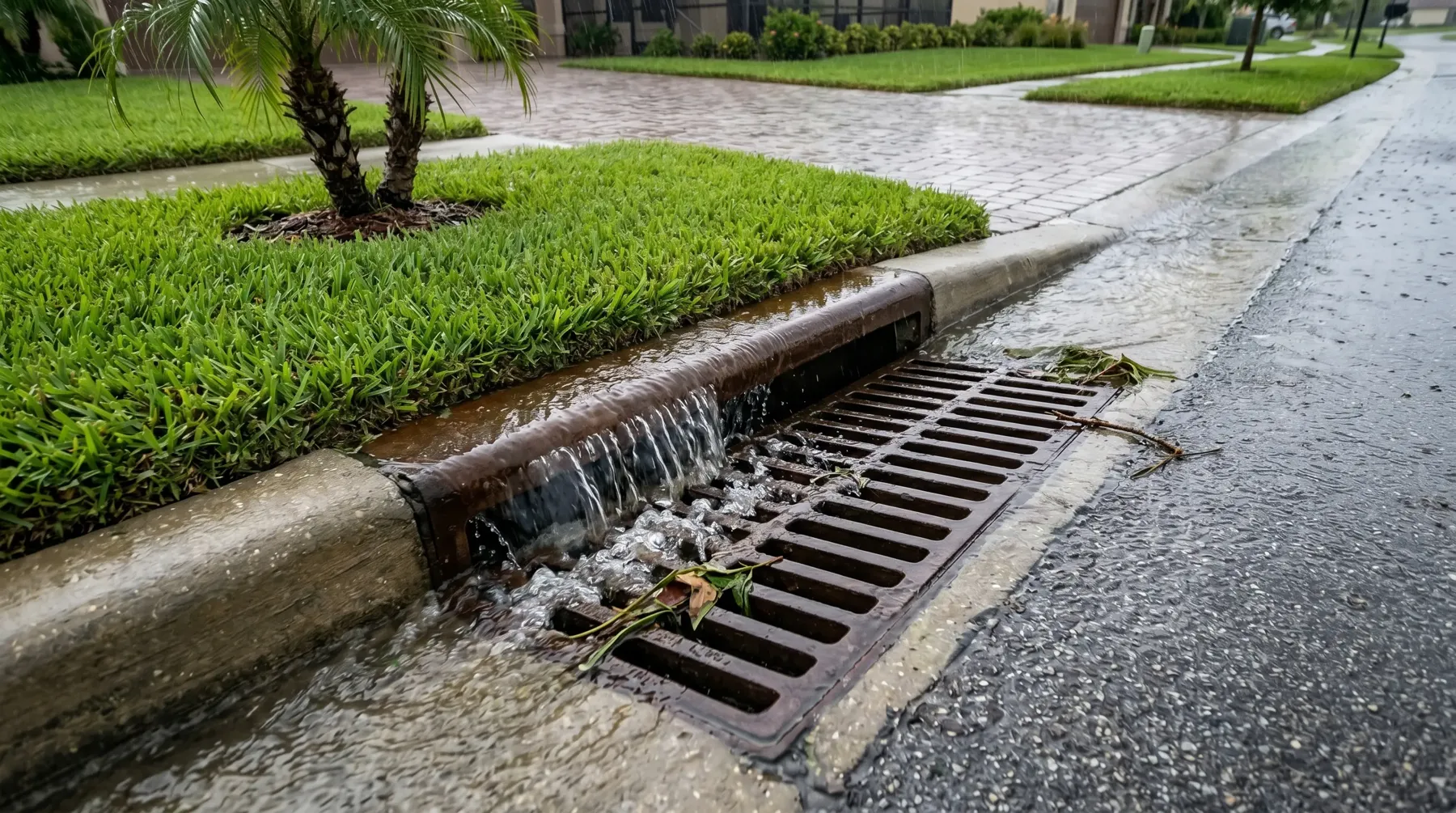
A summer storm in Southwest Florida can change a yard in less than an hour. Rain sheets off the roof, runs down the driveway, crosses the lawn, and gathers along the curb.
The common misunderstanding is that yard water is mostly a flooding issue. If the street drains and the yard dries out, the problem seems solved. But during the rainy season, stormwater runoff is a major water quality issue. The same rain that moves water off a property carries fertilizer, grass clippings, loose soil, pet waste, pesticides, and dissolved nutrients directly into the local water system.
In Southwest Florida, ordinary landscaping choices become stormwater management choices because our environment is wet, sandy, flat, and heavily engineered to move water quickly.
The Sheer Volume of Southwest Florida Stormwater Runoff
South Florida’s rainy season is not a gentle background condition. It arrives through repeated, intense downpours.
Consider the numbers: Fort Myers receives an average of 56 inches of rain per year, and roughly 70% of that falls between June and September. When that rain hits an impervious surface (like a roof or driveway), the volume of runoff adds up staggeringly fast:
- 1 inch of rain falling on a 1,000-square-foot roof produces approximately 623 gallons of runoff.
- In a typical SWFL summer, that single roof can generate over 25,000 gallons of runoff seeking a place to go.
Most modern neighborhoods are designed to shortcut natural water absorption. Roofs, driveways, roads, compacted lawns, and pipes are built to move water away from homes to protect buildings. The result is a faster connection between the yard and the canal, leaving little time for natural filtration.
Where Does Stormwater Go in Florida? (Hint: Not a Treatment Plant)
One of the most persistent misunderstandings in residential areas is the idea that storm drains work like sanitary sewers. They usually do not. Wastewater from toilets and sinks goes to a treatment plant or septic system. Stormwater from streets and yards is simply routed to the nearest low point in the watershed—a swale, retention pond, ditch, or canal—with little or no chemical treatment.
Because runoff is not clean rainwater by the time it reaches the drain, it poses an ecological threat. If fertilizer granules are left on a driveway, or if grass clippings are blown into the street, rainfall picks them up. In a canal-front neighborhood, water can move polluted runoff from turf to canal in a matter of minutes.
Why Fertilizer Bans Matter in Southwest Florida
Florida’s sandy soils drain quickly and do not hold dissolved nutrients the way heavier clay soils might. Nitrogen is highly mobile. Once dissolved in water, it moves downward into shallow groundwater or sideways toward canals and ponds.
The impact of this nutrient runoff is severe: Just 1 pound of phosphorus can generate up to 500 pounds of wet algae growth in local waterways.
Because the rainy season creates conditions where nutrient loss is almost guaranteed, local governments across Southwest Florida have enacted strict summer fertilizer bans to protect water quality.
SWFL Summer Fertilizer Blackout Periods
During these dates, the application of fertilizers containing nitrogen and phosphorus is strictly prohibited.
| County/City | Blackout Period | Key Rule to Remember |
| Lee County (Unincorporated) | June 1 – Sept 30 | Deflector shields required when applying near water the rest of the year. |
| City of Fort Myers | June 1 – Sept 30 | 10-foot fertilizer-free zone required from any water body. |
| City of Cape Coral | June 1 – Sept 30 | Zero phosphorus allowed year-round without a soil test. |
| Collier County | June 1 – Sept 30 | Applies to both homeowners and landscape professionals. |
| Charlotte County | June 1 – Sept 30 | 10-foot buffer required from all surface waters and wetlands. |
Note: Always check your specific municipality for exact ordinances, as rules occasionally update.
Turfgrass vs. Native Plants: Managing Yard Runoff
Many South Florida lawns grow in compacted fill soil left behind after construction. The surface may be covered with turfgrass (like St. Augustine), but turf roots are often concentrated within the top few inches of soil.
When rain falls faster than compacted soil can absorb it, water begins to run sideways, gathering speed and carrying loose soil and lawn chemicals with it.
Native plantings change that movement. Many Florida native plants develop deep, varied root systems that create channels in the soil, helping water enter the ground rather than running off.
Root Depth and Stormwater Function
Root depth dictates how well a landscape acts like a natural sponge.
| Plant Type | Average Root Depth | Stormwater Function |
| Standard Turfgrass | 2 to 6 inches | Low infiltration; prone to rapid runoff during heavy rain. |
| Native Groundcovers | 1 to 3 feet | Moderate infiltration; breaks up surface flow, stabilizes topsoil. |
| Native Grasses | 3 to 5 feet | Excellent infiltration; deep roots channel water deep into the sandy soil. |
| Native Trees/Shrubs | 5 to 10+ feet | Maximum infiltration; massive root networks absorb vast amounts of water. |
How Do Florida Retention Ponds Work?
Many subdivisions rely on retention ponds to hold stormwater. While they trap sediment, they are not unlimited filters. When too much nutrient-rich runoff enters a pond, warm water and sunlight encourage toxic algae blooms.
A pond with a bare or turf-only edge receives polluted water quickly. Conversely, a pond bordered with native wetland plants (like pickerelweed or duck potato) receives water differently. Their stems and roots create friction, trap particles, and absorb excess nutrients before they hit the water.
Best Native Plants for Southwest Florida Stormwater Management
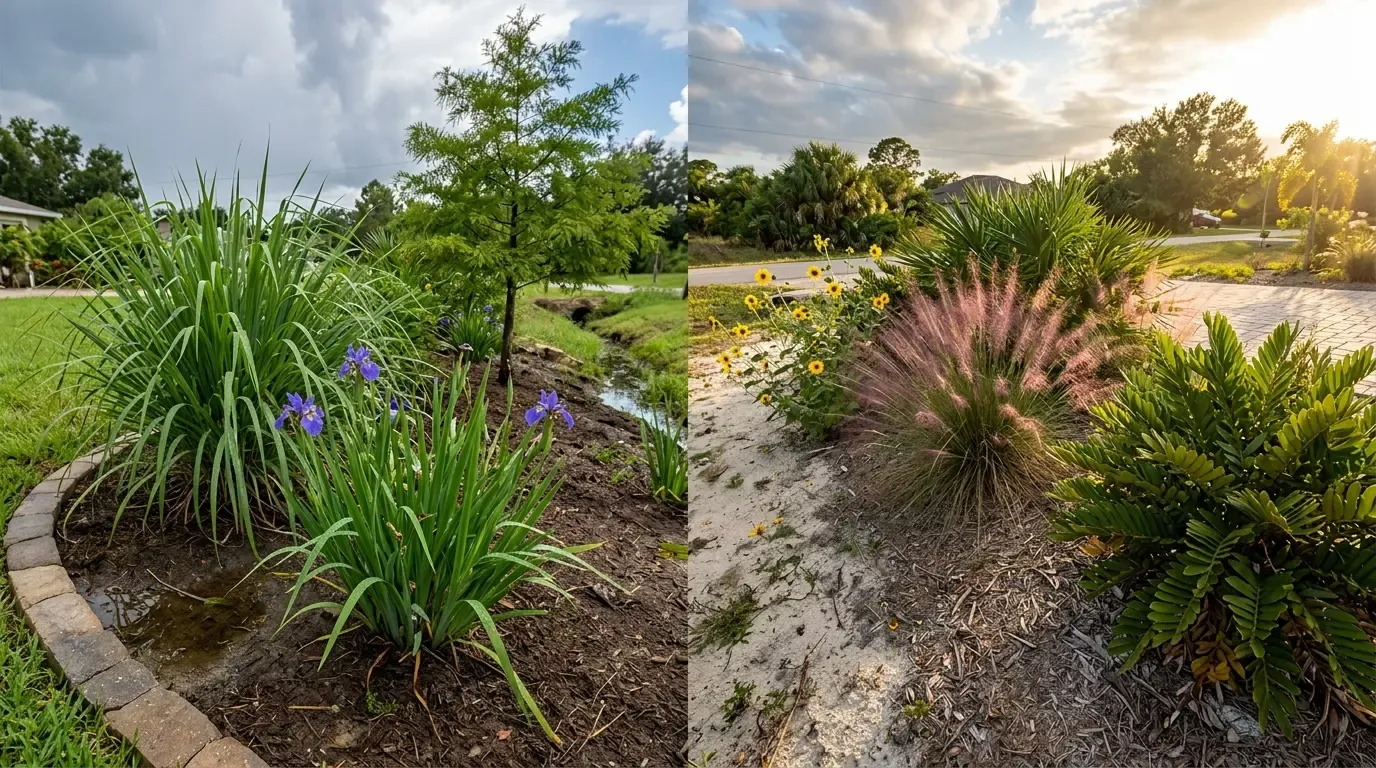
The best plant choice depends on your specific yard conditions. The goal is to place the right plants where they intercept runoff paths.
SWFL Native Plant Guide
| Landscape Zone | Moisture Level | Recommended Native Plants | Primary Benefit |
| Dry/Sunny Areas | Fast draining | Muhly Grass, Sunshine Mimosa, Dune Sunflower | Replaces turf, breaks up sheet flow across open soil. |
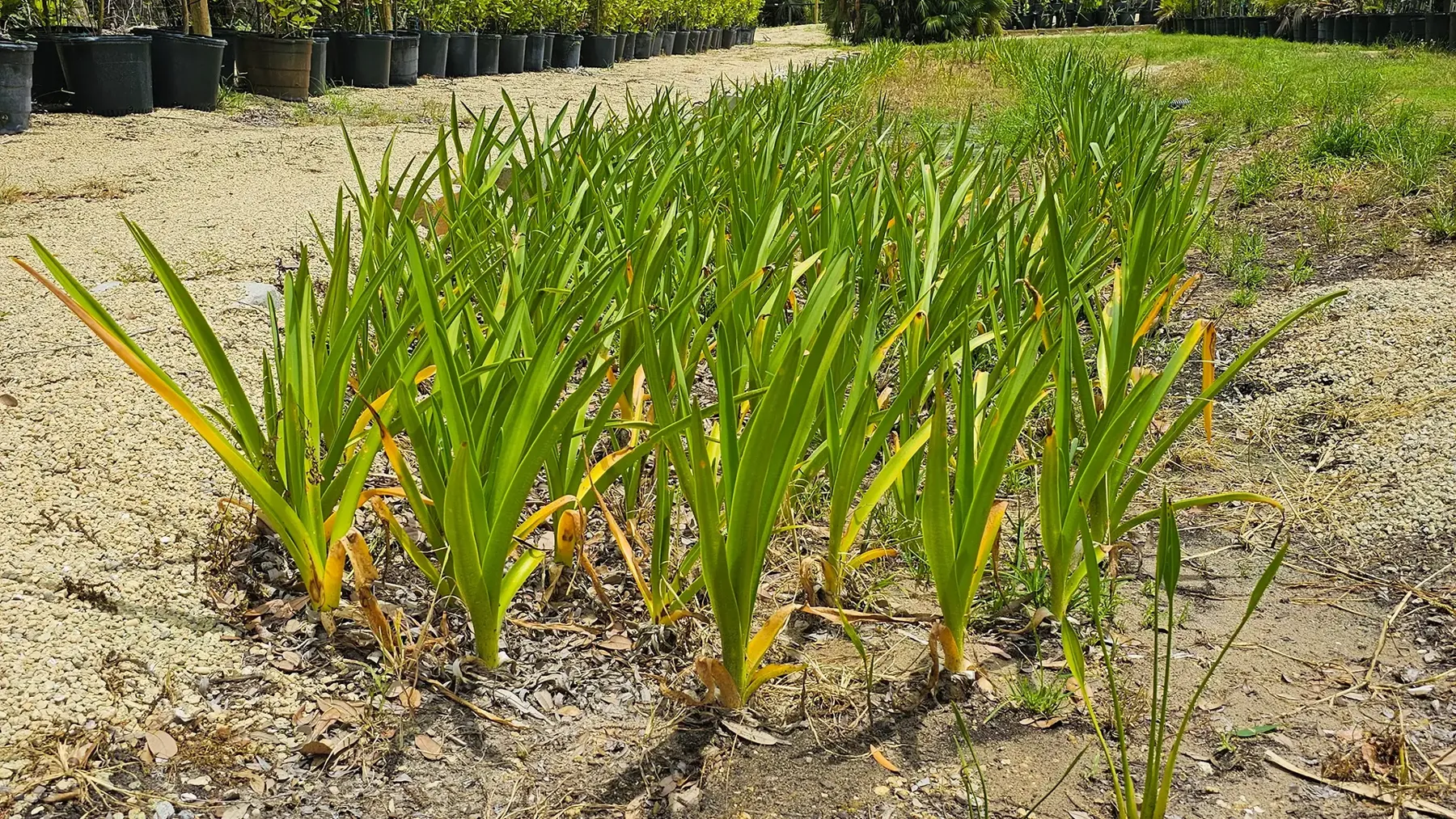
| Swales & Low Spots | Periodically wet | Fakahatchee Grass, Blue Flag Iris, Sand Cordgrass | Slows moving water, tolerates both dry spells and standing water. |
| Pond Edges | Saturated | Pickerelweed, Duck Potato, Golden Canna | Filters nutrients at the water’s edge, prevents bank erosion. |
| Buffer Zones | Variable | Simpson’s Stopper, Wax Myrtle, Buttonwood | Intercepts rainfall before it hits the ground, deep roots absorb volume. |
The Key Insight: Reading Your Yard Like a Watershed
Rainy season makes Southwest Florida’s water connections visible. The roof, lawn, driveway, swale, pond, canal, aquifer, and estuary are parts of one moving water network.
The point is not to blame individual homeowners for regional water problems, but to understand the mechanism. In a flat, sandy, rainy place like Southwest Florida, landscaping is never only decorative. During the rainy season, your yard is the front line of the coastal water quality system.
Frequently Asked Questions (FAQs)
When is the fertilizer ban in Southwest Florida?
For most of Southwest Florida, including Lee County, Collier County, Charlotte County, Fort Myers, and Cape Coral, the summer fertilizer ban runs from June 1 through September 30. During this time, fertilizers containing nitrogen and phosphorus cannot be applied.
Can native plants stop my yard from flooding?
While no plant can completely stop flooding from a major tropical storm, deep-rooted native plants significantly improve soil infiltration. This helps everyday summer rain soak into the ground faster rather than pooling on the surface or running off into the street.
Why is my neighborhood retention pond green?
Retention ponds turn green due to algae blooms. This is usually caused by excess nutrients (like nitrogen and phosphorus from lawn fertilizers and grass clippings) washing into the pond during heavy rains. Planting a buffer of native plants around the edge of the pond can filter these nutrients out before they reach the water.